Gingerbread House Template
Choose a house style and size, then print a template with every piece measured and labeled. It adjusts for dough thickness so the walls actually fit together.
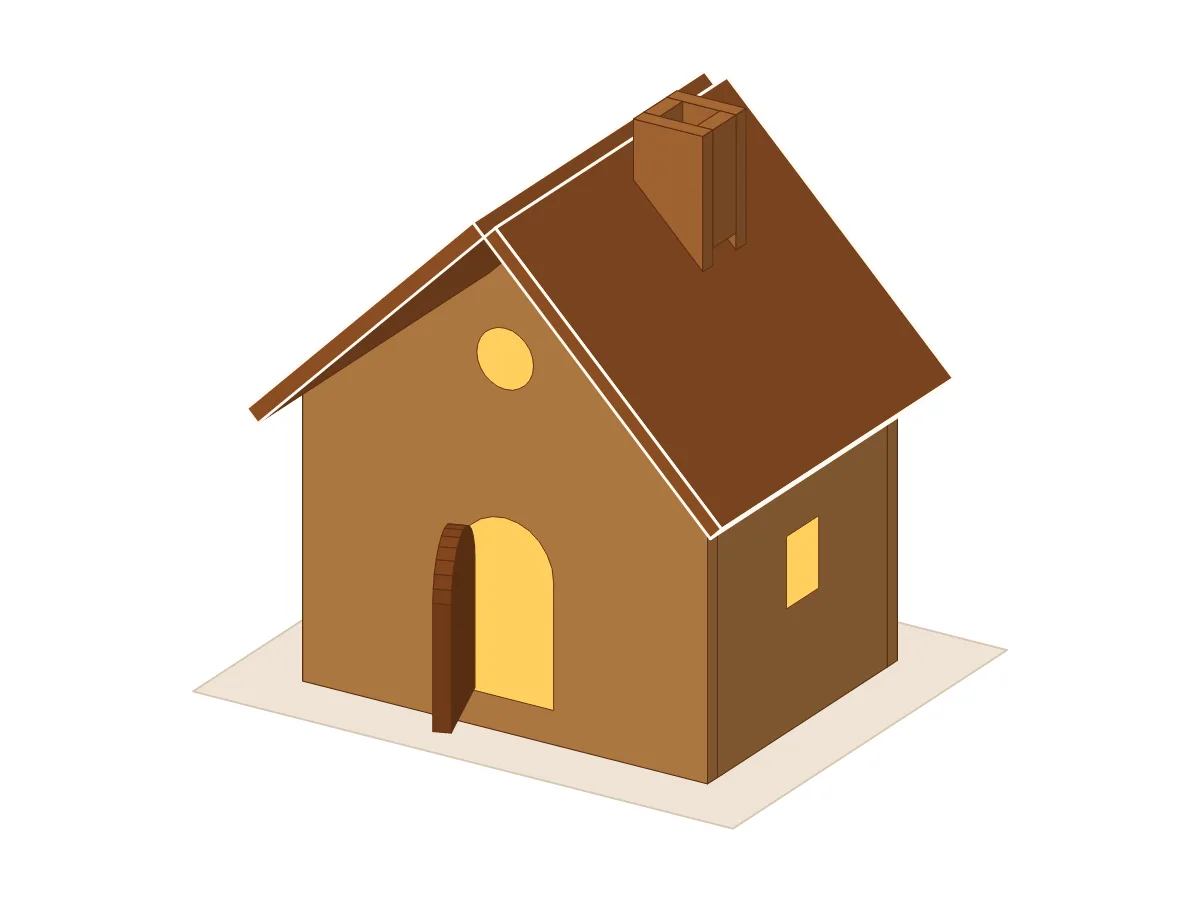
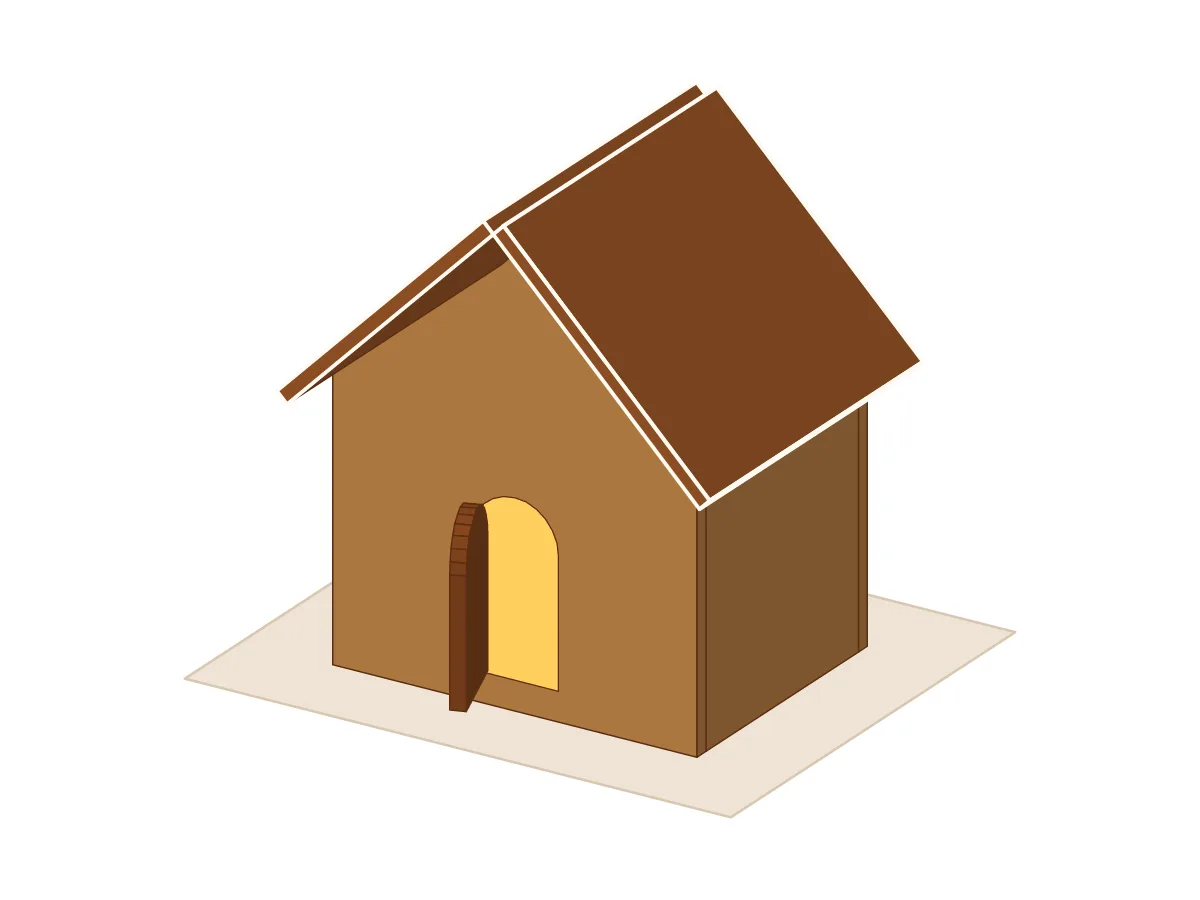
Assembled classic house, 6 × 4.5 × 4 inches
Print at 100% (Actual size). The check line should measure exactly 2 in5 cm.
Customize size
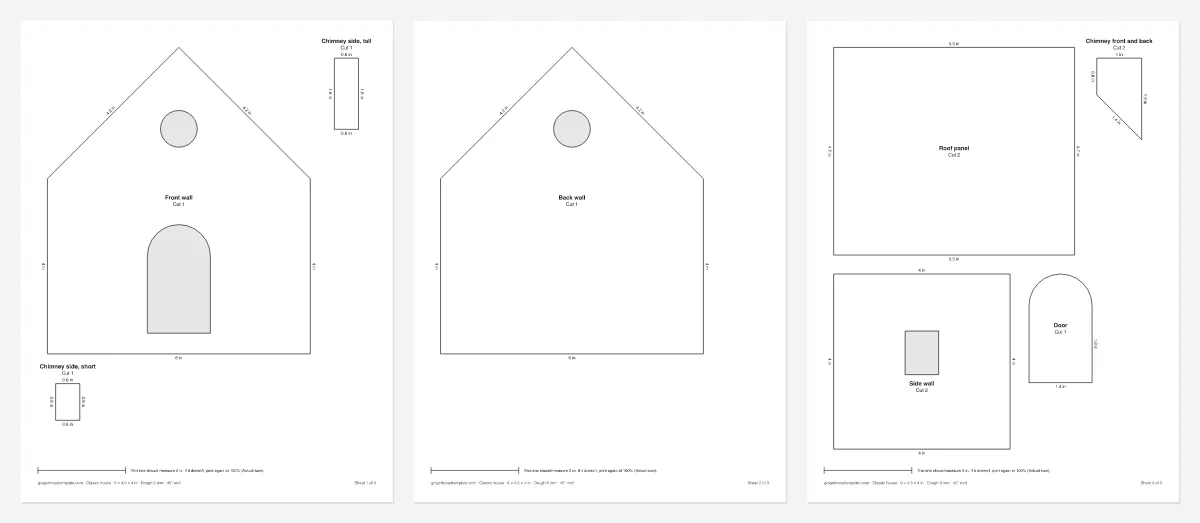
Gingerbread house pieces and measurements
The Medium classic house is 6 in15.2 cm wide and 4.5 in11.4 cm deep, with 4 in10.2 cm walls under a 45° roof. Here is every pattern it prints and the size of each. Change the house above and the list follows.
| Piece | Cut | Pattern size |
|---|---|---|
| Front wall | 1 | 6 × 7 in15.2 × 17.8 cm |
| Back wall | 1 | 6 × 7 in15.2 × 17.8 cm |
| Door | 1 | 1.4 × 2.5 in3.7 × 6.3 cm |
| Side wall | 2 | 4 × 4 in10.2 × 10.2 cm |
| Roof panel | 2 | 5.5 × 4.7 in14 × 12 cm |
| Chimney front and back | 2 | 1 × 1.9 in2.6 × 4.7 cm |
| Chimney side, short | 1 | 0.6 × 0.8 in1.4 × 2.1 cm |
| Chimney side, tall | 1 | 0.6 × 1.6 in1.4 × 4.1 cm |
| 11 pieces to cut from 8 patterns on 3 Letter sheets. | ||
- Dough
- You'll need about 2 lb (920 g)920 g (2 lb) of dough
- Board
- At least 8 × 6.5 in20.3 × 16.5 cm
The side walls are 4 in10.2 cm long, not 4.5 in11.4 cm. They stand between the front and back walls, so each one is shorter by twice the dough thickness (2 × 6 mm). That is why the finished house measures exactly 6 × 4.5 in15.2 × 11.4 cm on the outside instead of growing by the thickness of the dough at every corner.
How to use a printable gingerbread house template
- Pick the house and the size. Under Customize size, set the dough thickness to what you will really roll. The template uses that number to work out where the walls meet.
- Print at 100% (Actual size), not Fit to page. Measure the check line at the bottom of any sheet: it should be exactly 2 inches on Letter or 5 cm on A4. If it comes out shorter, the printer shrank the page and the pieces will not match.
- Cut out the paper patterns. If you like, trace them onto cardstock and tape the walls together first: a paper model shows whether everything fits before you bake.
- Lay the patterns on the rolled dough and cut around them with a sharp knife, windows and door included. Lift the extra dough away instead of moving the pieces, so they keep their shape.
- Bake, then put each pattern back on its warm piece and trim whatever spread. The assembly steps below cover baking times and the icing.
The Download PDF button saves the same sheets with a cover page that lists the pieces and the steps, handy if you print somewhere else or want a copy for next year.
How to assemble a gingerbread house
These steps follow the house you picked above, so they change if you switch to an A-frame or a church.
- Print the template at 100% (Actual size) and check that the line on each sheet measures exactly 2 in. Cut out the paper pieces.
- Roll the dough on parchment to 6 mm (about 1/4 in). Lay the patterns on it, cut around them and pull the extra dough away rather than moving the pieces, so they keep their shape.
- Cut out the windows and the door. Chill the cut pieces on the baking sheet before baking so they spread less.
- Bake until the pieces are firm. While they are still warm, lay each pattern back on top and trim the edges with a sharp knife. Let the pieces cool completely on a flat surface.
- Make royal icing with meringue powder or pasteurized egg whites and beat it to stiff peaks. Frosting is too soft to hold up walls.
- Pipe icing along the bottom and side edges of the front wall and one side wall. Stand them on the board at a right angle, with the end of the side wall tucked behind the front wall. Prop them with cans or jars.
- Add the second side wall, then the back wall. The side walls fit between the front and back walls, so the house measures exactly 6 in by 4.5 in on the outside.
- Let the walls set for at least 30 minutes, an hour if you can, before the roof goes on.
- Pipe icing on the sloped edges of the front and back walls and the tops of the side walls. Press on one roof panel, then the other, and hold them in place for a minute. The panels meet at their bottom edges, so fill the small V-shaped gap along the ridge with icing.
- Put the chimney together as a box on the work surface: the front and back pieces outside, the short side between them on the uphill end. When it has set, ice it onto the right side of the roof. The slanted bottom edges match the roof pitch.
- Ice the door to one side of the opening so it stands slightly open.
- Let the house dry for a few hours or overnight before you decorate.
What you'll need
- Rolling pin with thickness rings on Amazon (opens in a new tab)The rings roll the dough to the same thickness everywhere, which is the thickness the template is cut for.See on Amazon
- Meringue powder on Amazon (opens in a new tab)For royal icing without raw egg whites.See on Amazon
- Piping bags and tips on Amazon (opens in a new tab)A small round tip draws the glue lines along the walls and the icing on the roof.See on Amazon
- Cake board on Amazon (opens in a new tab)A firm base about 2 inches bigger than the house each way, so you can move it when it is done.See on Amazon
- Gingerbread cookie cutters on Amazon (opens in a new tab)Trees, people and stars from the leftover dough, to stand around the house.See on Amazon
- Gingerbread house kit on Amazon (opens in a new tab)Pre-baked walls and roof, if you would rather skip the baking this year.See on Amazon
gingerbreadtemplate.com is a participant in the Amazon Services LLC Associates Program, an affiliate advertising program designed to provide a means for sites to earn advertising fees by advertising and linking to Amazon.com.
How much dough you need
The generator adds up the area of every piece, subtracts the windows and the door, and multiplies by the thickness. It counts rolled dough at about 1.2 grams per cubic centimeter and adds 30% for scraps and re-rolling. For the Medium house that comes to about 2 lb (920 g)920 g (2 lb). Treat it as an estimate, not a recipe.
Recipes give their yield as a house size instead. One batch of a typical construction gingerbread recipe makes a house somewhere between 6 by 7 and 10 by 7 inches, so it covers the Medium house. For a Large or XL house, plan on more than one batch. The recipes we checked are listed on the About page.
Choosing a size
Width, depth and wall height are what you choose; the roof follows from the pitch. The presets below are a starting point, and any custom size from 2 to 20 inches wide works.
| Size | W × D × wall height | Dough | Good for |
|---|---|---|---|
| Mini | 2.5 × 2 × 2 in6.4 × 5.1 × 5.1 cm | 3 mm thick, about 3 oz (90 g)90 g (3 oz) | Ornaments, place cards and mug toppers. |
| Small | 4 × 3 × 3 in10.2 × 7.6 × 7.6 cm | 4 mm thick, about 10 oz (290 g)290 g (10 oz) | A first house or a kids' table; the easy template is this size. |
| Medium | 6 × 4.5 × 4 in15.2 × 11.4 × 10.2 cm | 6 mm thick, about 2 lb (920 g)920 g (2 lb) | A centerpiece that one batch of dough covers. |
| Large | 9 × 7 × 6 in22.9 × 17.8 × 15.2 cm | 7 mm thick, about 6.3 lb (2.9 kg)2.9 kg (6.3 lb) | A show piece with an inner brace under the roof. See the large template. |
| XL | 12 × 9 × 8 in30.5 × 22.9 × 20.3 cm | 8 mm thick, about 12.6 lb (5.7 kg)5.7 kg (12.6 lb) | Several batches of dough and pieces split across sheets. |
Bigger houses get thicker dough by default, because the walls carry more weight. Keep the board in mind too: it should be about 2 inches larger than the house each way, so a Medium house needs a board of at least 8 × 6.5 in20.3 × 16.5 cm.
FAQ
What size should a gingerbread house template be?
For a first house, around 6 inches wide is a comfortable size: one batch of dough covers it and it sits on a dinner plate. Go smaller for kids or mug toppers and larger for a centerpiece. Since this template is generated, the size is whatever you type in, from 2 to 20 inches wide.
How thick should gingerbread be for a house?
House dough is usually rolled 1/8 to 1/4 inch thick, and walls that carry a roof are stronger at 1/4 inch (about 6 mm). The presets here go from 3 mm for a mini house to 8 mm for XL. Whatever you choose, enter the thickness you actually roll, because the template is cut for it.
Why don't my gingerbread house walls fit together?
Three causes come up again and again:
- The template ignores the thickness of the dough, so the side walls are too long by twice that thickness. This one subtracts it.
- The dough spread in the oven. Trim each piece against its pattern while it is still warm, and bake until firm: underbaked pieces can warp.
- The printer scaled the page. If the check line is not exactly 2 in (5 cm), print again at 100%.
Can I print the template on A4 paper?
Yes. Pick A4 under Paper and the pieces are laid out again for the taller, narrower sheet. Measurements switch to centimeters on their own; you can change that under Units. The check line on A4 sheets is 5 cm.
How do I print a large template on regular paper?
Pieces that don't fit on one sheet are split into parts with a 10 mm overlap. Each part carries gray strips and lettered + marks: lay the sheets so the matching marks sit on top of each other, tape them, and cut the piece out as one.
Can I use this template for cardboard or paper?
Yes. Set the thickness to your material and the joints are worked out for it. For cardboard there is a cardboard version with a roof that folds instead of two panels. A paper model in card stock is also a good way to test a custom size before you bake.
How far ahead can I bake the pieces?
Bake them a day or two before you build, so they cool and harden. Kept in an airtight container, separated by waxed paper, in a cool place, they last a week or two. Humidity is the enemy: it softens the gingerbread and stops the icing from setting.
More gingerbread house templates
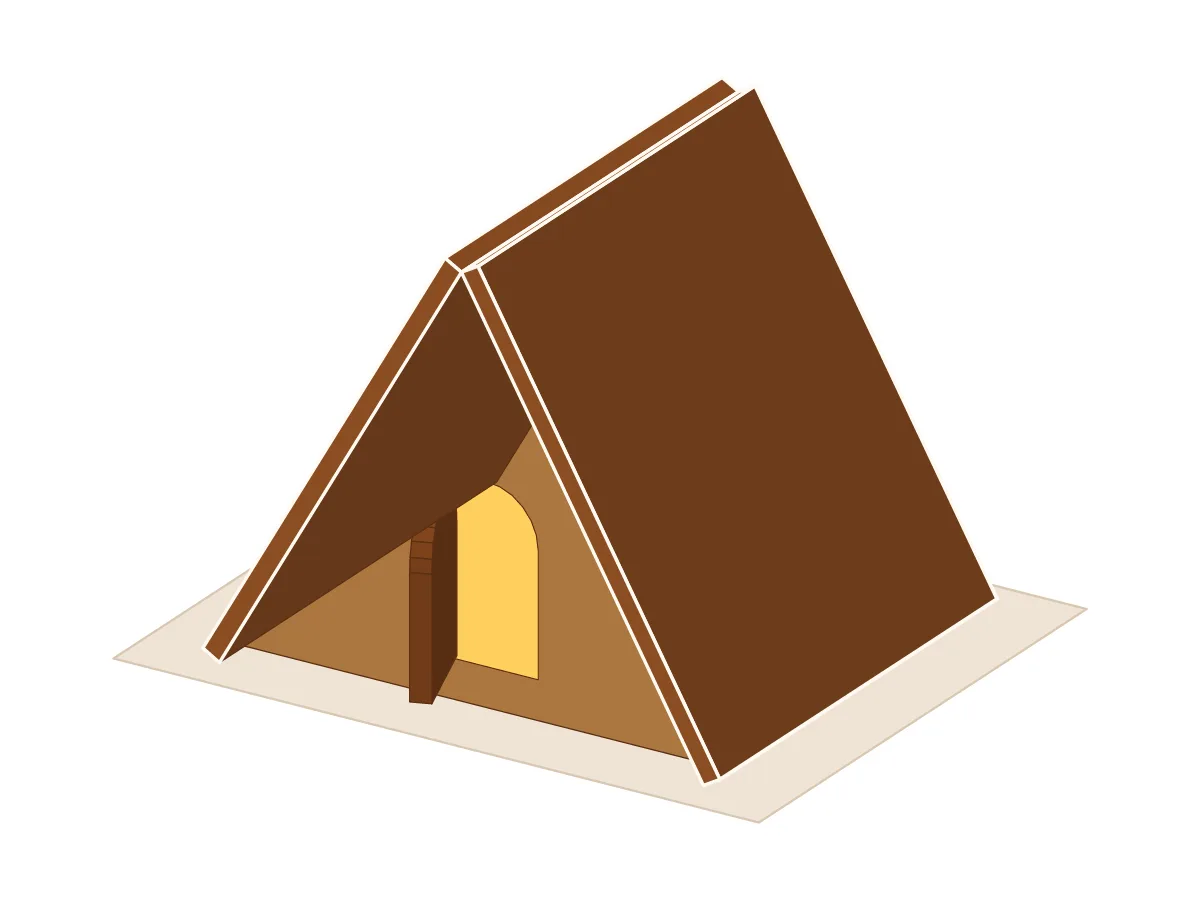 A-frame gingerbread houseTwo triangles and two panels that are both roof and walls.
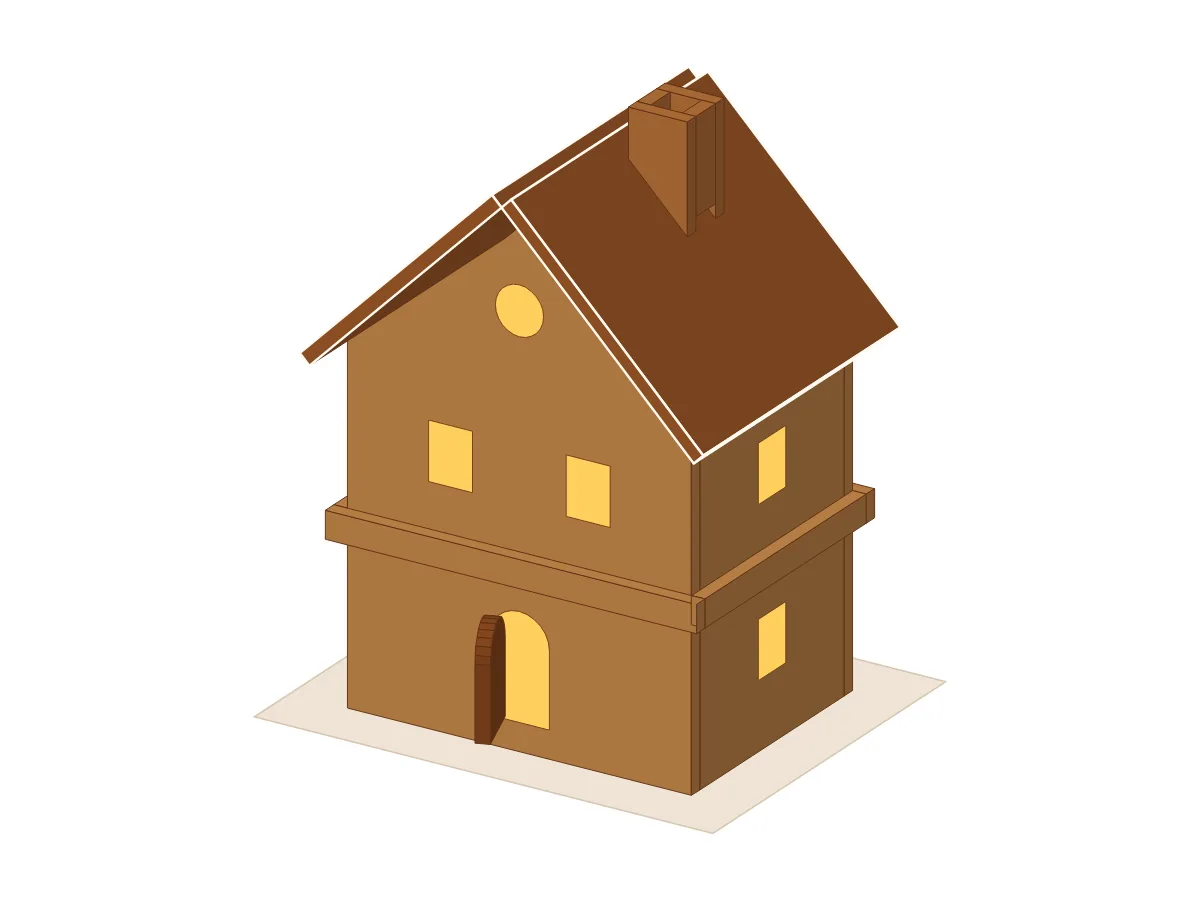 Two-story gingerbread houseTall walls, two rows of windows and a band between the floors.
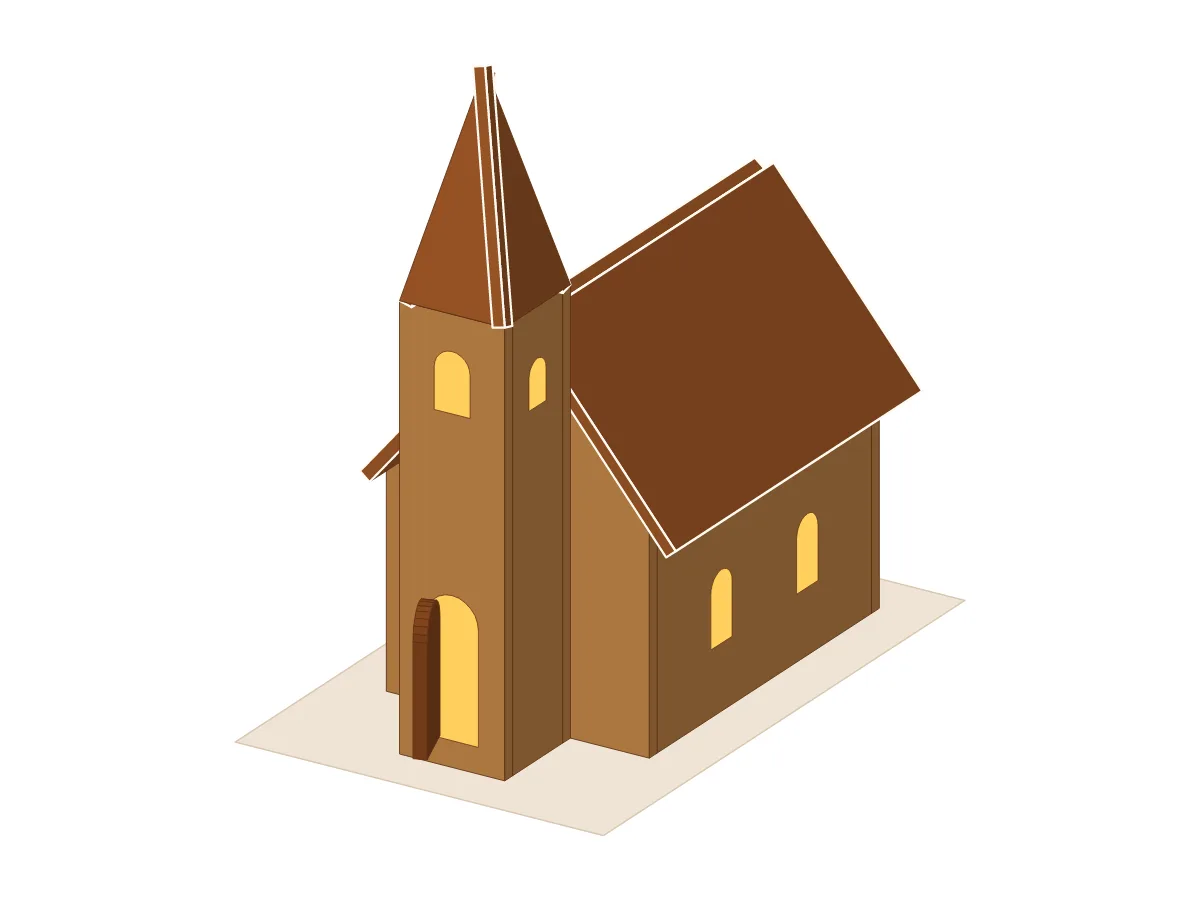 Gingerbread churchA long nave, a square tower in front and a four-sided spire.
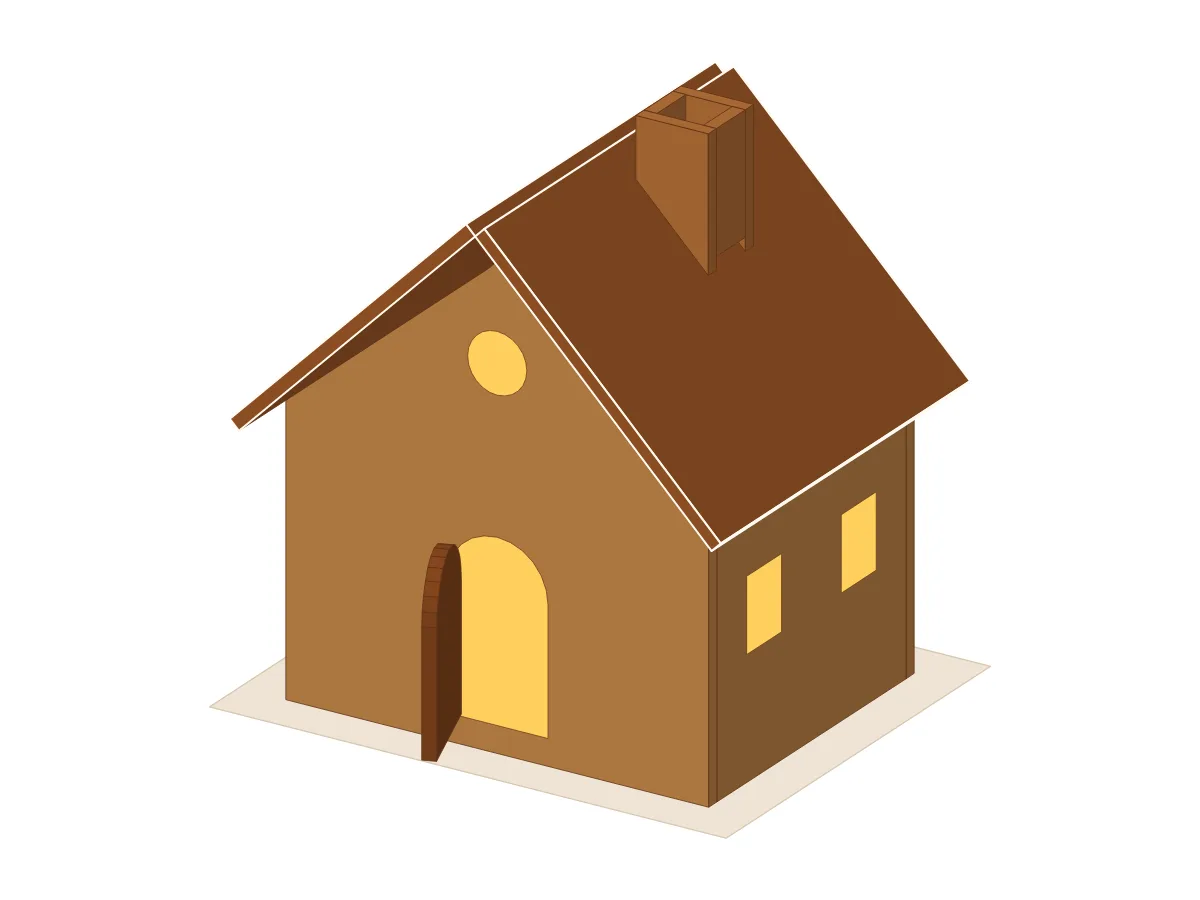 Large gingerbread houseA 9-inch house with thicker dough and an inner brace for the roof.
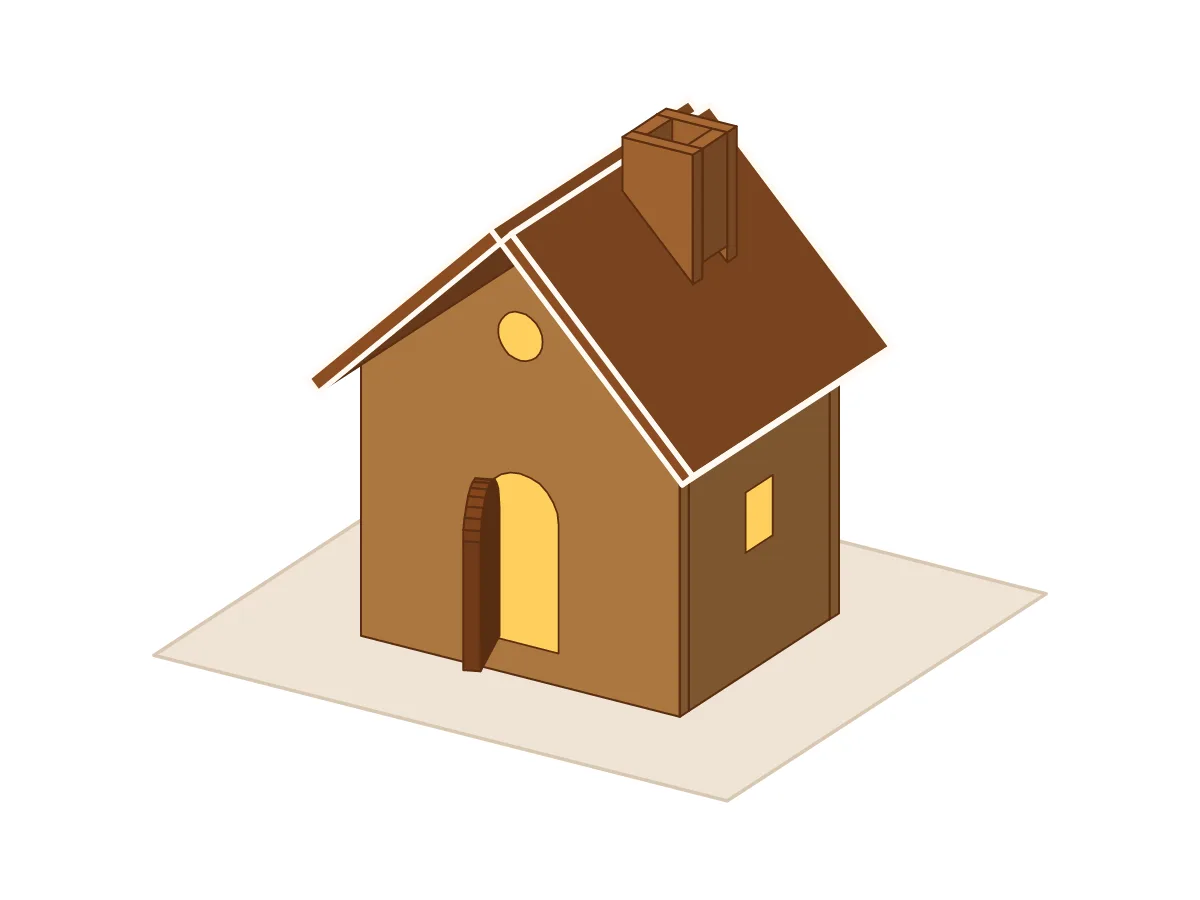 Mini gingerbread houseA 2.5-inch house, with an option to make it a mug topper.
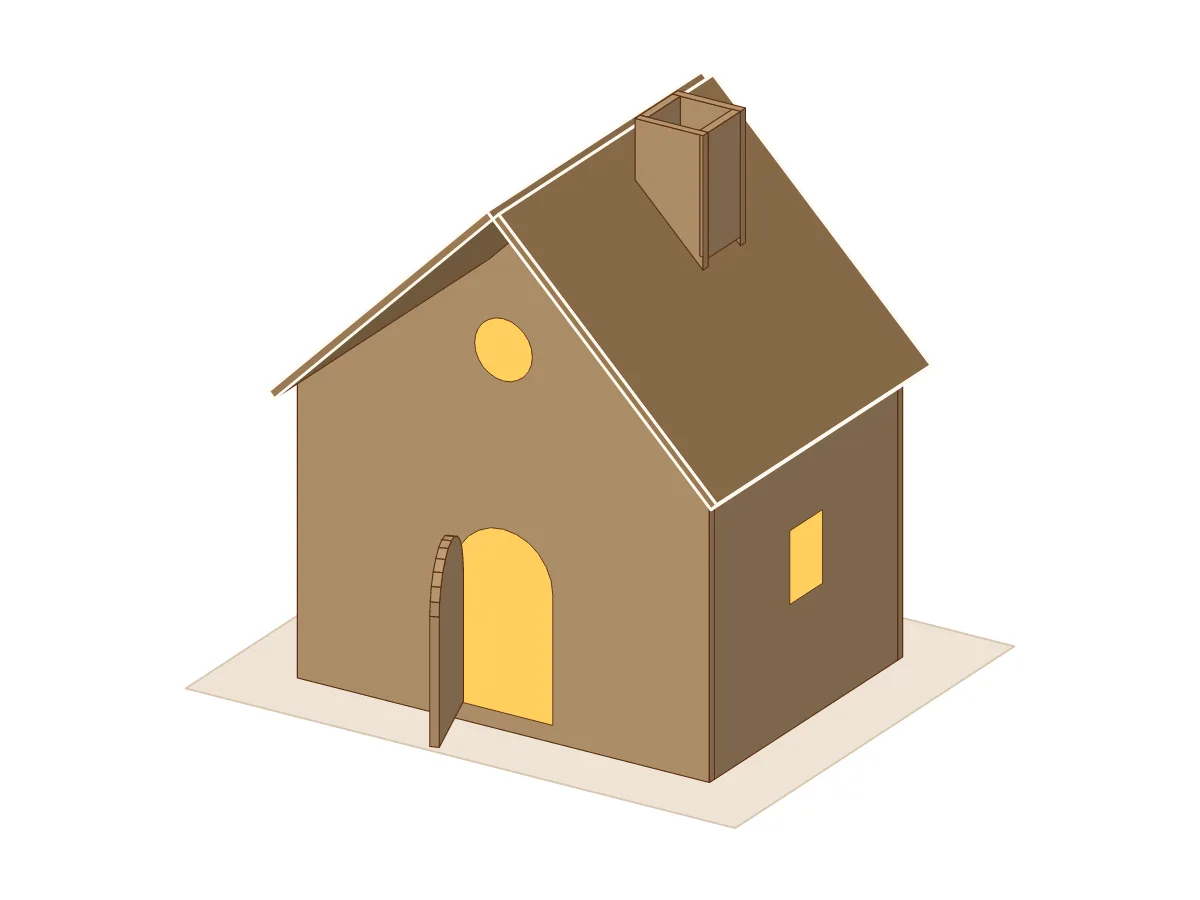 Cardboard gingerbread houseFor 3 mm cardboard, with a folded roof. Decor you can keep.
 Easy gingerbread houseA small house with five patterns to cut and no chimney.